
‘2013 Journey’ Category
» posted on Monday, January 7th, 2013 by Linda Lou Burton
Still In Tallahassee
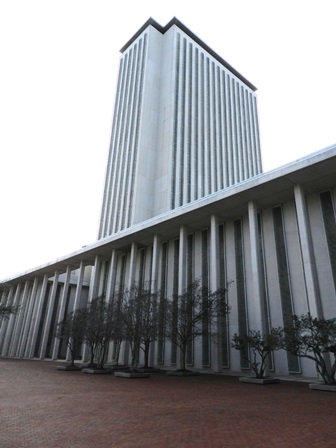 Linda Burton posting from Tallahassee, Florida – “This plaque is dedicated to Senator Lee Wisenborn whose valiant effort to move the Capitol to Orlando was the prime motivation for the construction of this building.” A touch of humor, and a telling dedication. The nontraditional Florida capitol is the newest in the country, a modern 22-story tower that rises 307 feet from the public entrance on the Plaza Level to the Observation Deck. It is the fourth building to serve as Florida’s capitol; officially dedicated March 31, 1978. Immediately after its opening, restoration began on the Old Capitol, which sits in front of the new “like a jewel,” with white columns, picturesque grounds, and (although they were down the day I was there) red-striped awnings over the windows. The Old Capitol is a museum today, refurbished to its 1902 appearance, but it was almost bulldozed during the controversy over how to gain space, and where to do it. Tallahassee is not centrally located in
 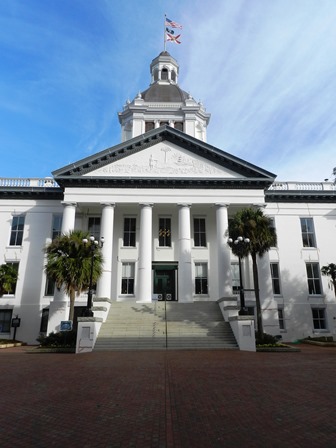 the state now, but it was in the beginning. The Spanish colonies of East Florida and West Florida had capitals in St Augustine and Pensacola; the establishment of Florida territory in 1822 merged the two. The first session of Florida’s Legislative Territorial Council met at Pensacola; members from St Augustine traveled fifty-nine days by water to attend. The next year they met in St Augustine; western delegates traveled around the peninsula on a twenty-eight-day trek. That’s when they agreed on a halfway point, and that was Tallahassee, an abandoned Apalachee settlement. The third session, in 1824, met in a log-cabin; the precedent was set for Tallahassee as capital city. A two-story structure replaced the cabin in 1826; the third capitol was completed by 1845. And the fourth I’m standing in today, despite the “valiant effort” of Senator Wisenborn. » read more
» posted on Thursday, January 3rd, 2013 by Linda Lou Burton
Those Lucky Kids
 Linda Burton posting from Tallahassee, Florida – Florida State University is famed for football, to be sure. The Seminoles just wrapped up their 2012 season with an Orange Bowl victory over Northern Illinois. But this post focuses on something else FSU is famous for, and that is the Florida State Circus. Ladies and Gentlemen, Boys and Girls, and Children of All Ages, come see the show, come to be entertained, come for the color and the fanfare, come to learn some high-flying skills, because Florida State campus has a Big Top! This exciting program has been around since 1947 and was started when the school went co-ed. It’s not a degree program, it’s an extra-curricular activity under the Student Affairs division and was designed to give male and
  female students “something to do together.” You must be a degree-seeking student registered at FSU to participate. Unless you’re a lucky kid (between 7-17) in the Summer Program on the Tallahassee campus, or at the resort at Callaway Gardens in Pine Mountain, Georgia. Which takes me back to 1973, when my kids were among those lucky kids. But first, about the Circus program itself. » read more
» posted on Tuesday, January 1st, 2013 by Linda Lou Burton
Happy Birthday!
 Linda Burton posting from Tallahassee, Florida – The first day of the year is a perfect day for reflection. A glance over the shoulder and we can still glimpse the past, even though our feet are firmly pointed towards the new year ahead. But this year Floridians are giving the past much more than a quick glance; you see, it’s Florida’s 500th Birthday and Viva Florida 500 is about to begin. It was 1513 when Juan Ponce de Leon arrived on Florida’s east coast; the first group of Europeans to document such a landing, and to name the place La Florida. Florida’s documented material history dates back more than 12,000 years, but Spain’s claim in 1513 began a new era in human history; it was the foundation that eventually formed the United States of America. The legacy of Spanish Florida started with Ponce de Leon and continued
  when Pedro Menendez founded St Augustine in 1565, the oldest continuously occupied European settlement in North America. But Spanish explorers were not the only ones; the French established Fort Carolina in 1564; and the British displaced the Spanish in the late 18th century. Under these various flags lived settlers of multiple nationalities; today a number of different cultures thrive in Florida. Viva Florida 500 is about them all, celebrated with a year-long, statewide, big birthday bash. » read more